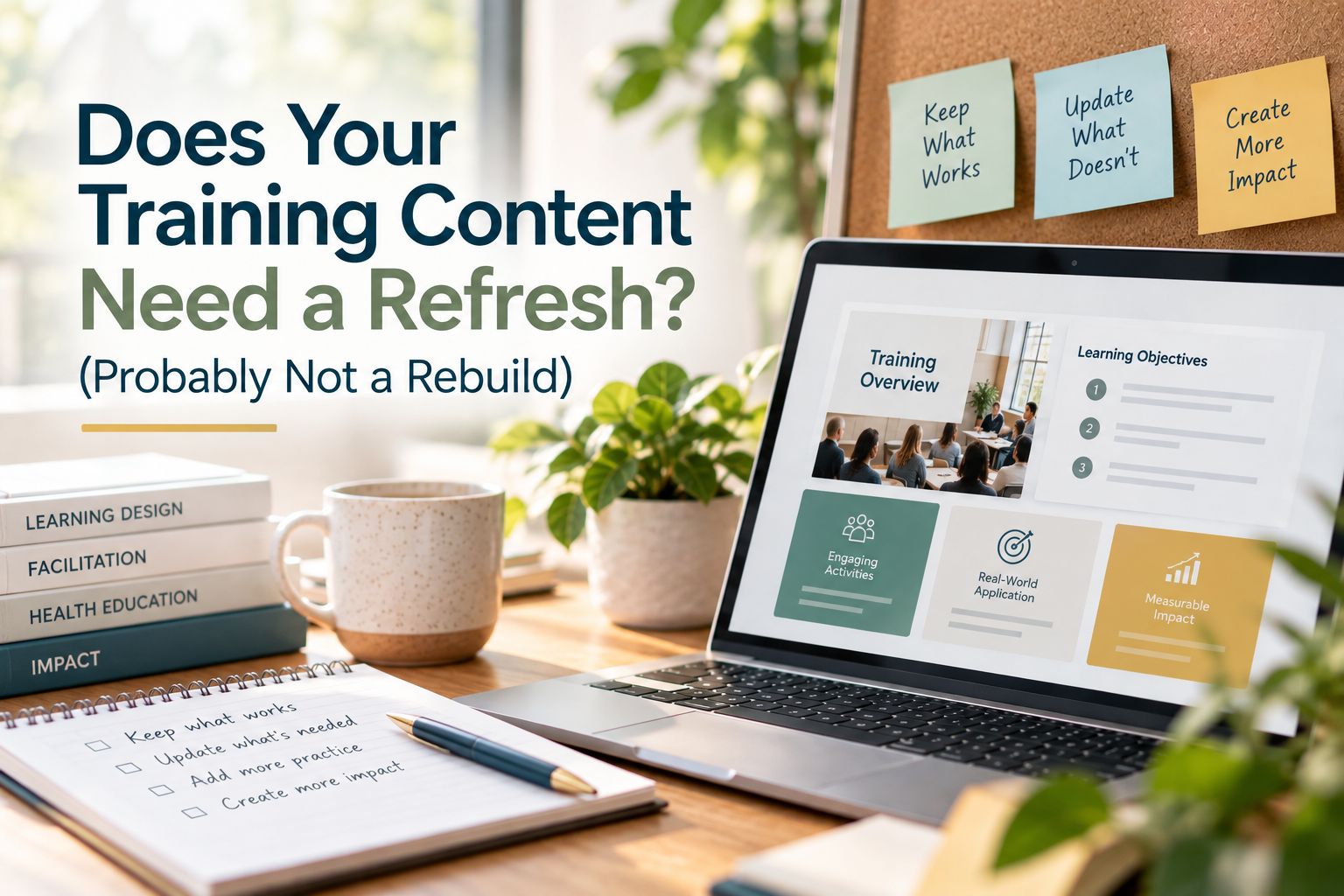
This year, three clients came to me with almost the same request.
They had training content they were proud of. They’d facilitated it multiple times, people showed up, participants were engaged, and evaluations were positive.
They weren’t looking to start from scratch. They already had content that worked, and they wanted a fresh perspective on how to make it even better.
And honestly, I love this kind of project.
Not because I don’t enjoy building something new, but because I believe there’s often more potential in what already exists than we realize.
As you plan for the year ahead, taking a closer look at your existing training might be one of the most valuable things you do.
You don’t always need more content. Sometimes, you need to make better use of the content you already have.
Why Refreshing Usually Beats Recreating
One of the first things I look for when working with a client is what’s already working.
What do participants respond to? Which activities spark conversation? What do people remember? Where are they asking for more guidance or opportunities to practice?
These are valuable clues. And if you’ve already delivered the training, you have something to work with: real experience, participant feedback, and a better understanding of what your audience needs.
Starting from scratch means potentially throwing all of that away.
Refreshing gives you an opportunity to keep what works, rethink what doesn’t, and make intentional changes based on what you’ve learned.
It can also save time and resources while building on the expertise your team has already invested.
But there’s another reason I like this approach: learning design is an iterative process. Your audience changes. Your organization’s priorities evolve. The skills people need to do their jobs well shift over time. Even a well-designed training can benefit from a second look.
The goal isn’t to keep content around forever. It’s to make sure the learning experience continues to serve its purpose.
And sometimes, that means starting over.
If the underlying policy has changed, the audience is completely different, or the training no longer supports your organization’s goals, a refresh may not be enough. You don’t want to spend time polishing something that no longer meets the need.
The trick is knowing the difference.
Signs Your Training Content Is Due for a Refresh
You probably don’t need a formal audit to recognize that something isn’t quite working. Here are a few signals I look for:
Your evaluations keep telling you the same thing. Participants love the content but wish they had more time to practice. That’s useful feedback. It might mean the training needs less presentation and more application.
You’re skipping slides when you facilitate. If you routinely breeze past certain sections, ask yourself whether that information is still necessary or whether there’s a better way to deliver it.
Your examples feel dated. The data is old, the tools have changed, or you’re still referring to something as the “new process” three years later.
The training only works when one particular person delivers it. If the facilitator has to fill in the gaps, explain what’s missing, or make the activities work on the fly, the learning experience may need more intentional design.
People leave with information but little idea what to do with it. Participants can recall what you presented, but can they apply it to their work? If not, the issue might not be the content itself. It might be how the learning is designed.
It’s longer than it needs to be. People are short on time, and AI has made information easier than ever to access. Learners don’t necessarily need a 90-minute e-learning course to get information they could find elsewhere. If your training is packed with content but light on opportunities to practice, reflect, or apply what they’ve learned, it’s worth revisiting what needs to stay and what could be streamlined.
That last point is especially important to me.
There’s a difference between giving people information and helping them learn what to do with it. A refresh is an opportunity to close that gap.
How Do I Decide What to Refresh and What to Let Go?
When I help teams refresh training content, I draw on the Owens-Kadakia Learning Cluster Design Model, developed by Crystal Kadakia and Lisa Owens and discussed in their book Designing for Modern Learning: Beyond ADDIE and SAM.
The model encourages a more intentional approach to modern learning, including making thoughtful use of existing content rather than automatically creating something new.
Here’s how I put that thinking into practice.
1. Take inventory of what you have.
Before you start editing slides or brainstorming new activities, get a clear picture of what already exists.
List your training materials, including their titles, formats, intended audiences, and primary topics. Gather past evaluations, facilitator notes, and other feedback, too.
You’re looking for the full picture, not just what’s sitting in the slide deck.
2. Check alignment with what people need now.
Next, consider two questions:
Does this training still support our organizational priorities?
Does it address what learners need to know and be able to do?
These questions matter because content can be accurate, well organized, and thoughtfully designed while still addressing the wrong problem.
Start with the desired outcome. What should people be able to do differently after this experience? Then work backward to determine whether the existing content supports that outcome.
3. Look at the learning experience, not just the content.
This is where things get interesting.
When I review training, I’m not just checking whether the information is accurate or the slides look good. I’m looking at how people will engage with the material, make sense of it, practice using it, and carry it into their work.
The Learning Cluster Design Model offers a useful lens for examining whether your learning experience reflects the needs of today’s learners. Here are a few elements I pay attention to:
Current: Examples, data, and tools reflect today’s realities.
Chunked: Information is organized into focused, manageable pieces rather than delivered in one long stretch. (More on this in Stop Teaching Everything.)
Experiential: Learners have opportunities to practice, solve problems, and work through realistic scenarios.
Social: People learn with and from one another through discussion, collaboration, and shared experiences.
For Me: The content reflects learners’ roles, experiences, and contexts, helping them connect new information to what they already know.
Accessible: Materials and activities are designed to reduce barriers and make learning easier to access and use.
You don’t need to check every box just for the sake of checking it. The point is to identify where your training is already strong and where a change could meaningfully improve the experience.
Sometimes, a small adjustment makes a big difference. Sometimes, the review reveals a bigger opportunity to rethink how the learning happens.
4. Decide what deserves another look.
Once you understand what you have, what learners need, and where the gaps are, you can make more informed decisions.
Refresh what’s still relevant but could work harder. Maybe the content is solid, but the delivery relies too heavily on presentations. Perhaps the examples need updating, learners need more opportunities to practice, or a lengthy e-learning course could be broken into shorter, more focused experiences. These are opportunities to build on what already works.
Let go of what’s no longer serving a purpose. Some content is outdated, no longer aligned with organizational priorities, or simply unnecessary. Other information may still be useful but belong somewhere else, such as a job aid or resource library rather than a live training session. Not everything needs to make the cut.
The goal isn’t to refresh everything. It’s to make intentional decisions about where your time and resources will have the greatest impact.
What Could This Look Like in Practice?
Imagine your team facilitates a three-hour workshop. Participants consistently rate it well, but they also ask for more opportunities to practice.
You review the materials and discover that the core content still aligns with your organization’s goals. A few slides need updating, and most of the session is spent presenting information that participants could engage with in other ways.
Instead of rebuilding the entire workshop, you keep the stories and frameworks participants respond to, update the outdated information, and redesign parts of the experience.
You introduce realistic scenarios for small-group practice, break up the presentation with opportunities to reflect and discuss, and create a one-page job aid participants can use after the workshop.
The content hasn’t been thrown away. It’s been put to better use.
And that’s the opportunity a refresh creates: you can preserve what makes your training valuable while rethinking how people experience and apply it.
What This Means for You
You don’t have to throw out good content to make it better.
If your training has a solid foundation, start there. Look at what participants value, what they need more of, and what has changed since you first developed the material.
Then ask yourself:
What’s already working, and what would help it work even better?
You might discover that a few targeted updates are all you need. Or you might uncover an opportunity to redesign the learning experience in a way that better supports understanding, practice, and application.
Either way, you’ll be making decisions based on what your learners need, rather than defaulting to creating something new.
Not sure where to start? Begin with an inventory of your existing training materials and participant feedback. Getting everything in one place can help you see where to focus your attention.
Ready to give your training a refresh?
I’ve developed Content Refresh, part of my advisory services at SMART Health Education, to help teams take a more intentional approach to the training content they already have.
Together, we’ll look at what’s working, what’s no longer serving your learners, and where thoughtful changes could create a more engaging and effective learning experience.
You don’t always need to start from scratch. Sometimes, you just need a fresh perspective on what you’ve already built.
Kind Words from Clients
“Kimberly is someone who really prioritizes staying informed on the cutting edge of adult learning and development. I get the impression she does that in her spare time just for fun, and she definitely brings it to the table professionally.”
-BCT Partners